
Online Microclots Clinical Diagnosis Test
Take the free online version of the Microclots/HHM Clinical Diagnosis Test, which Dr. Aguirre-Chang digitalised with our team.
For the physical blood test for microclots, click here
This test gives you a clinical diagnosis regarding the severity/level of hyperperfusion, hypercoagulability, and microclots in Long Covid, Post Vaccine Syndrome, ME/CFS, and other Chronic Illnesses, and whether further investigation is meaningful.
*If you have issues scrolling down, use the scroll bar instead of touch scroll. (Scroll to the very bottom to get to the submit button)
Please allow 1-2 working days to receive your results by email. By submitting the online HHM test above, you agree to us storing and processing the data submitted and using it for research. You agree to our privacy policy and to being signed up to our newsletter/blog.
Dr. Gustavo Aguirre-Chang and Dr. Aurora Trujillo F. developed this online test in August 2022 for the diagnosis of symptoms of Hyperperfusion, Hypercoagulability, and Microclots.
Microclot Blood Test (Biocode)
We also offer a Microclot diagnostic blood test by Biocode/Inus Lab:
This test goes beyond measuring Amyloid Fibrin Microclots (ThT+); it also detects Amyloid Fibrin-negative Microparticles (ThT-).
Both ThT+ and ThT- particles are clinically relevant, as scientists have observed significantly higher levels of both particle types in Long Covid patients compared to healthy controls. ThT- particles are of particular interest in combination with apheresis treatment.
This test not only assesses the total quantity of ThT+ and ThT- particles, but also identifies that size plays a crucial role in microclots. Using state-of-the-art imaging flow cytometry, the test analyses a high number of microclots with high precision, allowing for a detailed and reliable assessment. For example, small microclots are frequently upregulated in Post-Vac patients, whereas medium-sized microclots do not show the same pattern.
Altogether, 20 different parameters are monitored in this test.
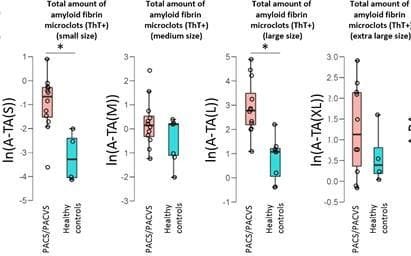
Example of Microclots Test Result
Other Long Covid and Post Vac topics:
Push the button to get to the respective topic
ARTE TV Documentary ‘Long Covid – Healing in Cyprus’
ARTE TV Documentary ‘Long Covid – Healing in Cyprus’ about our Apheresis Center
The documentary aired in June 2024. A team of journalists from the European TV channel ARTE TV accompanied three of our Long Covid and Post Vac Syndrome patients and interviewed them and our team at the Apheresis Center. Here you can watch an excerpt of the documentary, which is also easy to watch for patients with cognitive dysfunction, brain fog, and related migraines. English audio by Dubly.
Since the documentary was filmed, new scientific findings have been made; you can find the latest studies published here.
Markus has published a blog post here, where he describes the developments and updates since the documentary was filmed.
Microclots FAQ
There isn’t one telltale symptom that points straight to microclots. What most people describe is a mix of problems that all trace back to poor circulation and lingering inflammation.
Fatigue is the big one, and it’s usually the kind that feels completely out of proportion to what you’ve actually done. Brain fog comes up a lot, too. People talk about struggling to concentrate, losing words mid-sentence, or feeling like their memory just isn’t what it used to be.
Then there’s exercise intolerance. Even a short walk or a few minutes of light activity can leave you feeling wiped out for hours or even days afterwards. Shortness of breath, muscle aches, joint pain, and tingling or numbness in the hands and feet are all common. Some people notice their hands and feet are always cold, or that their skin looks different in colour. Heart palpitations or a racing heart rate come up frequently as well.
The tricky part is that all of these symptoms overlap with other conditions. So they’re a reason to investigate further, not a diagnosis on their own.
Most of the research so far has focused on people with Long Covid. And in that group, microclots show up far more often than in healthy individuals. Some imaging studies have found roughly 20 times higher levels compared with healthy controls.
Researchers have also spotted them in other chronic illnesses and post-viral conditions, though less frequently. Beyond that, we don’t have great data yet. Because testing for microclots isn’t part of routine clinical practice, the full picture is still coming together.
This is different from microclots. A standard blood clot, whether it’s a deep vein thrombosis or a pulmonary embolism, can be a medical emergency. Here’s what to watch for:
- Sudden swelling in one leg or arm
- Pain or tenderness that might feel like a cramp or Charley horse
- Skin that’s warm to the touch, red, or discoloured over the affected area
- A visible, swollen vein that feels firm or cord-like
If the clot has moved to the lungs, you might experience sudden shortness of breath, chest pain that gets worse when you breathe in, a rapid heart rate, or coughing up blood.
Any of these, especially sudden one-sided swelling, chest pain, or breathlessness, means you should get emergency medical help straight away. Don’t wait.
It’s one of the most promising theories researchers are exploring right now. The logic is fairly simple. If microclots are partially blocking tiny blood vessels, then less oxygen and fewer nutrients are reaching your tissues. Your muscles feel it. Your brain feels it. And the result is that heavy, relentless fatigue so many people describe.
Several studies have found a link between microclot markers and the severity of someone’s fatigue, particularly in Long Covid and ME/CFS patients. But finding a link isn’t the same as proving one thing causes the other. Fatigue is complex and usually has more than one driver. So microclots look like an important piece of the picture, but are probably not the whole story.
Yes. This is actually where the bulk of the research has been happening. Teams led by researchers like Resia Pretorius, along with groups studying thromboinflammatory biomarkers, have consistently found abnormal microclots in the blood of Long COVID patients. These clots tend to stick around rather than clearing the way normal clots do.
One reason they’re so stubborn is that they often get tangled up with something called neutrophil extracellular traps, or NETs. These are sticky webs that immune cells release. The microclots found in Long Covid patients tend to be bigger, more numerous, and harder for the body to break down than what you’d see in a healthy person. That’s why they’ve attracted so much research attention.
It really depends. Superficial clots, or the ones in veins close to the surface of your skin, often do improve on their own within days to weeks. Movement, keeping the leg elevated, and basic anti-inflammatory care usually help.
But you shouldn’t assume a clot is superficial without having it checked. Deeper clots need proper treatment, whether that’s H.E.L.P. Apheresis or anticoagulation therapy, because there’s a real risk of the clot travelling to the lungs.
And microclots are a different situation altogether. They don’t follow the body’s normal clotting-and-healing cycle. Research suggests they’re unusually resistant to the body’s natural clot-dissolving processes, which means they may not clear on their own. Scientists are still working to understand how they behave over time.
Right now, there are a few approaches:
- Symptom-based screening questionnaires. The one developed by Dr. Gustavo Aguirre-Chang and Dr. Aurora Trujillo F. is a well-known example. It looks at whether your symptom pattern fits with hyperperfusion, hypercoagulability, and microclot-related issues.
- Specialised blood tests that use imaging flow cytometry to directly detect and count microclot particles. Only a small number of research labs and specialty clinics currently offer this.
- Related blood markers like D-dimer or newer angiogenesis-related biomarkers. These can flag abnormal clotting activity, though they weren’t specifically designed to pick up microclots.
It’s worth noting that testing options are still limited and evolving. If you suspect microclots, a clinic with experience in this area will be better placed to guide you than a standard GP visit.
It won’t directly create one. But when you’re dehydrated, your blood gets thicker and more concentrated. And that makes it easier for clots to form, especially if you already have other risk factors like sitting still for long periods, recovering from surgery, taking hormone therapy, or living with a clotting disorder.
The good news is that staying hydrated is one of the simplest things you can do to support healthy blood flow. It’s not a guarantee against clots, but combined with regular movement, it’s an easy habit that genuinely helps.
In most cases, yes. Current medical guidance actually favours gentle walking and normal movement over bed rest for confirmed superficial thrombophlebitis. Moving around helps your calf muscles pump blood back up through the veins, which may reduce the chance of the clot spreading deeper.
Doctors often recommend combining gentle activity with leg elevation when you’re resting, warm compresses, and compression stockings where appropriate.
But here’s the important caveat. This advice only applies when the clot has been properly confirmed as superficial. If you’re dealing with new swelling, pain, or redness in your leg, see a doctor first. A deep vein clot needs a completely different approach.